
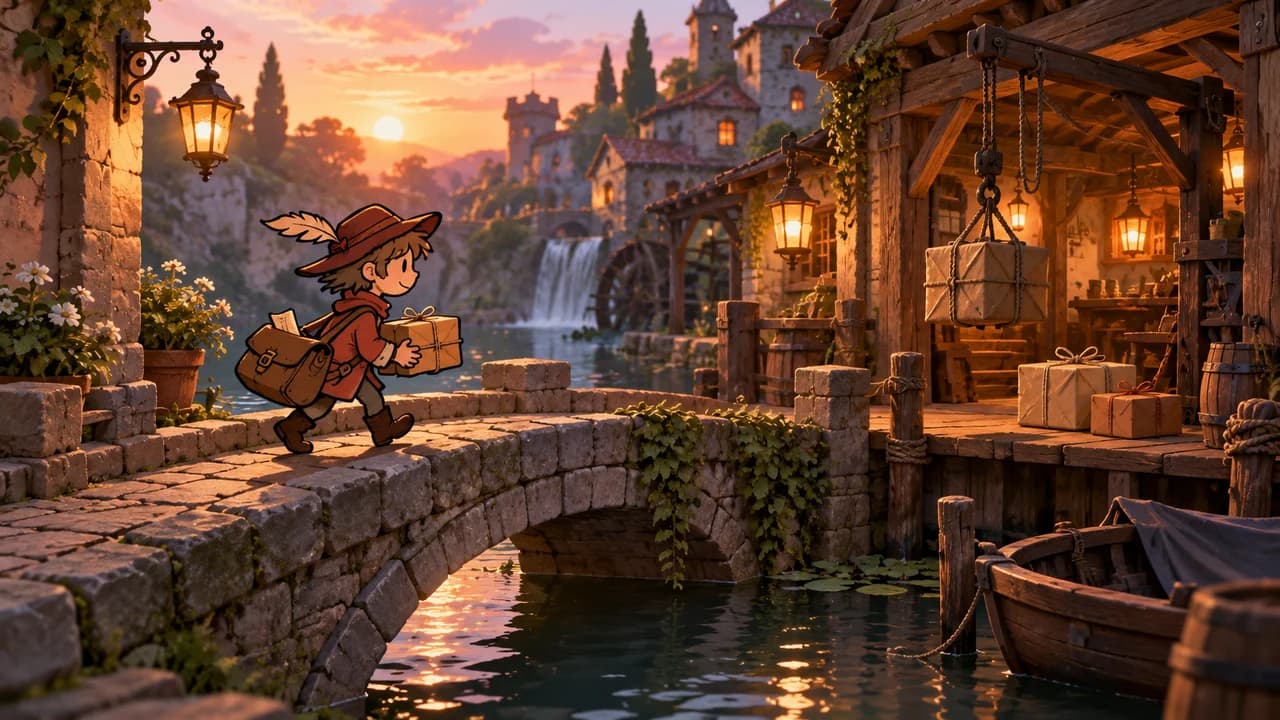
Art stylesGeometricHigh contrast
Drawn sprites in 3D worlds
Paper-like or drawn sprites inhabit navigable 3D spaces, retaining graphic characters and spatial perspective. Contour and animation rules distinguish this from pixel hybrids.
Traits
- Define sprite-facing rules
- Use shadows and foot contacts to explain space
- Keep 3D edges subordinate to drawn contours
Play that fits
Useful for paper-like adventures, platform exploration and turn-based combat; free cameras add facing and occlusion work.
Reference games
Make a coherent game art set
Suggested asset specification
- Character: multi-direction drawn poses
- Scene: restrained 3D modules
- UI: icons matching character line weights
Motion and feedback
Check flips, turns and airborne poses; rotating sprite planes must not misrepresent landing positions.
Main production effort
Full character modeling may be avoided, but directional animation, transparency sorting and camera adaptation remain.
Start with this small scene
One left/right drawn courier delivers to three workshops on a fixed-view 3D bridge.
Simplify for a smaller budget
Use a fixed camera and two actor directions, limiting spaces that require viewing the reverse side.
What to check
Do sprites disappear or intersect around props, and do feet/shadows explain depth order?
Take the art specification
Includes localized visual rules, asset suggestions, scope and sources. This is a specification; assets still need production for your project.
Art specification v1 · Original editorial and examples · Reference-game assets not included
Prompt examples
Drawn sprites in 3D worlds. Define sprite-facing rules. Use shadows and foot contacts to explain space. Keep 3D edges subordinate to drawn contours. One left/right drawn courier delivers to three workshops on a fixed-view 3D bridge.
Drawn sprites in 3D worlds. Character: multi-direction drawn poses|Scene: restrained 3D modules|UI: icons matching character line weights. Check flips, turns and airborne poses; rotating sprite planes must not misrepresent landing positions.. Do sprites disappear or intersect around props, and do feet/shadows explain depth order?
Common pitfall
Pasting a portrait onto a plane does not solve collision, facing or occlusion in 3D movement.
Observations and sources
Cases refer to public documentation. Developers and community wikis are credited separately; document review is not a claim of hands-on testing.
- Demon Turf: Queens Edition
Observe 2D character facing, shadows and landing cues on 3D platforms.
- Bug Fables: The Everlasting Sapling
Compare paper-like actors' depth relationships and palette within dimensional exploration scenes.
Brief for the studio
Opens the AI studio with the brief below in the input. You can edit it. Nothing starts automatically.
Make a single-screen delivery game: click destinations, deliver three parcels, then finish or restart. Use Drawn sprites in 3D worlds. One left/right drawn courier delivers to three workshops on a fixed-view 3D bridge.
Related entries

Live-action video
Filmed performances become interactive through editing, search or branching. Video clips are the main assets; a cover is only a directional illustration.
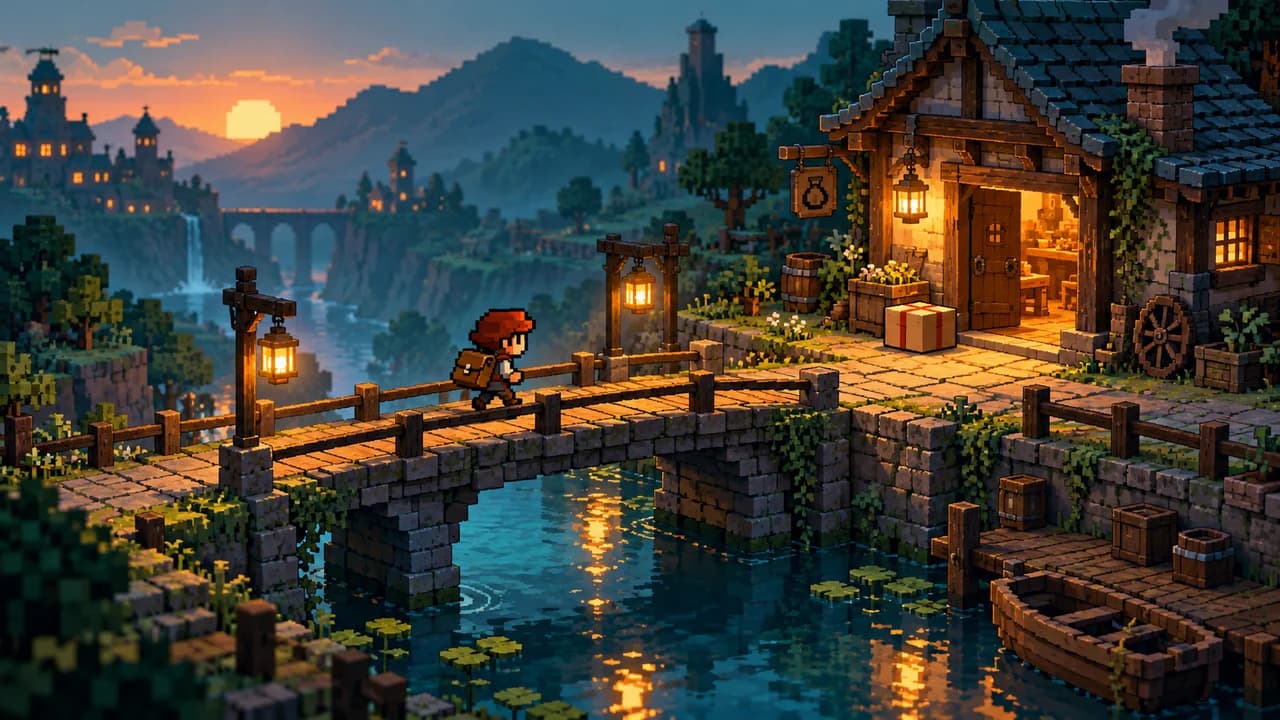
Pixel characters in 3D scenes
Pixel characters share space with dimensional sets, lighting and cameras. This hybrid needs consistent scale rather than blur applied to a flat background.
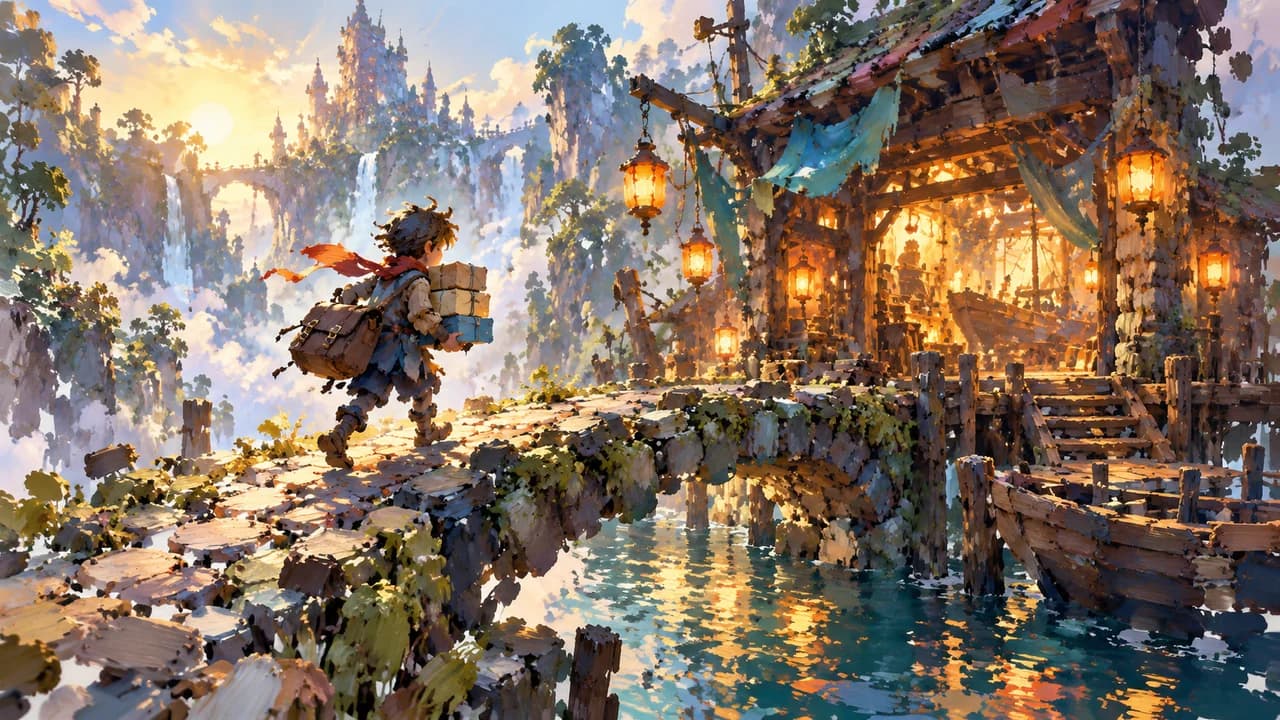
Volumetric brushwork 3D
Brush-like marks and loose color masses help form spatial volumes with open, painterly edges. This describes a visual result, not one shared rendering technique.
Covers are original AI-generated style illustrations. Game names reference publicly visible design choices and remain the property of their owners. This atlas does not supply screenshots or assets from those games. Prompts and combinations are original drafts for new games.